Northside is changing and many “old Northsiders” have accepted and even embraced the resulting ethnic and socio-economic diversity — including students as well as new immigrants–and have formed alliances with other activists fighting tirelessly to preserve a sense of community. You can see that their hard fought efforts are paying off whenever you step into the Rogers Road or the Hargraves community center at about three p.m. any day of the week.
Every day after school, community activists and volunteers are hard at work and at play with all kinds of kids from the surrounding neighborhoods: African-American, Latino, Burmese (Karen), and white kids are eating delicious snacks prepared for them on-site. They are reading, doing homework, and shooting hoops with college kids and other volunteers; and they are bonding with each other, the way kids do– just by being around each other day in and day out and sensing that they are being treated equally and with respect by the adults in the room.
Many people who lived through segregation will say they were raised by an entire community–-neighbors, teachers, preachers, relatives–-and that they were expected to be respectful and play well with others. At the community centers, the same thing is happening today.
The same forces are at work– loving and caring– even if the kids no longer live in the same neighborhood, attend the same church, or go to the same schools, as Northsiders used to. Families aren’t as interconnected, don’t live so close together and don’t depend on each other the way “old” Northsiders did. Something got lost, but thanks to so many activists, there’s still a lot happening every day that is making kids feel a part of something bigger.
On a day right before the Thanksgiving holiday, I asked a spunky third-grader who lives on Craig Street in Northside what she was thankful for. She responded, “I am thankful that I can have a birthday party and invite kids from my neighborhood and that I can play with them whenever I want.” As most parents will tell you, such a thing is rare these days. Parents shuttle kids all over town when they get together for “play dates” and parties.
But Olivia seems to have what Northsiders used to have: enough similar-aged neighborhood kids for a birthday extravaganza. Guests likely reflected the ethnic diversity of today’s Northside. Community is alive in Northside because its long-time residents largely have accepted change, welcoming new families and students even while resisting and challenging developers and landlords who are indifferent to Northside’s historical importance and community spirit. And yet, a party like Olivia’s would never have taken place in Jim Crow Chapel Hill: her party was hosted by her parents, Jason, who is white, and Donna, who is black.
Donna grew up in the eastern Carolina town of New Bern, and she moved to Chapel Hill to attend UNC. She bought her first house in Northside in 2002: “There are ways in which people characterized this neighborhood, and I was like, but it looks just like where I grew up. This is–I mean I don’t understand why people are afraid, or, you know, think that this is somehow a bad or safe neighborhood.” 1 After she got married, she and her husband moved into a house around the corner where they are raising Olivia and Finn, Donna’s stepson.
Donna loves the idea of her children growing up in a place where they interact with their neighbors constantly and where someone is always watching out for whoever is playing in the streets: “I was raised by a single mom and that meant that I learned to be really independent and to be as self-sufficient as possible. But I also learned that being totally self-sufficient is not good, so you have to have a support system, you can’t isolate.” Just as Olivia said, the neighborhood has a lot to offer an active child: a park and pool nearby, and lots of places to get good food and drink, all within walking distance. But for Donna and Olivia, it’s mostly about having your friends close by: “We played a lot in the streets, which is why it’s so important for me to live somewhere Olivia has friends who are right across the street, and they’re in the street, or in someone’s house, because that’s what I grew up with.”
This also is what makes the neighborhood attractive to families looking to live in a downtown community. But as demand rises, so do the prices. Donna the politician believes “the economics don’t work as far as keeping this a working class, family-oriented neighborhood. But we’ll see how it changes with the new elementary school.” Donna the mother believes that keeping it family-oriented would be great for a whole lot of parents and kids.
And some of the new residents are getting the message and joining seasoned neighborhood activists. They seem to have slowed the tide of disruptive change and succeeded in drawing attention to would be irretrievably lost if market forces aren’t reigned in. Since the establishment of the Northside Neighborhood Initiative, a coalition of community partners dedicated to affordable housing, dozens of properties have been purchased and made available to families at below-market rates. In 2019, the number of African Americans in Northside rose for the first time since 1980. 2
Many current residents are trying to set the terms for the new Northside. Some of those residents have been fighting for years. These days, activists’ voices sometimes rise about the din of bulldozers, excavators, and jackhammers, letting the town know that they will not be moved. If, as many of them hope, the arc of the universe bends toward justice, then history is on their side.
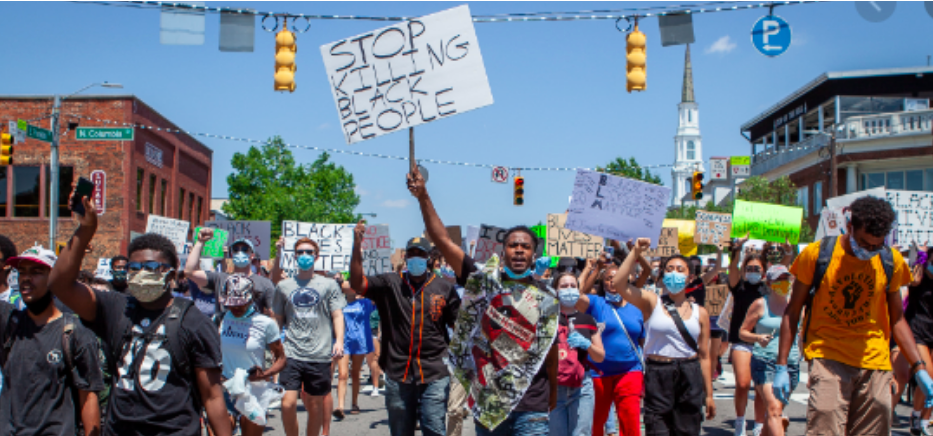
I have written a lot about the Northside community and other historically black neighborhoods in Chapel Hill. And I also have written about the influx of developers who have been turning family homes into student housing.
Northside is changing and many “old Northsiders” have accepted and even embraced the resulting ethnic and socio-economic diversity — including students as well as new immigrants–and have formed alliances with other activists fighting tirelessly to preserve a sense of community. You can see that their hard fought efforts are paying off whenever you step into the Rogers Road or the Hargraves community center at about three p.m. any day of the week.
Every day after school, community activists and volunteers are hard at work and at play with all kinds of kids from the surrounding neighborhoods: African-American, Latino, Burmese (Karen), and white kids are eating delicious snacks prepared for them on-site. They are reading, doing homework, and shooting hoops with college kids and other volunteers; and they are bonding with each other, the way kids do– just by being around each other day in and day out and sensing that they are being treated equally and with respect by the adults in the room.
Many people who lived through segregation will say they were raised by an entire community–-neighbors, teachers, preachers, relatives–-and that they were expected to be respectful and play well with others. At the community centers, the same thing is happening today.
The same forces are at work– loving and caring– even if the kids no longer live in the same neighborhood, attend the same church, or go to the same schools, as Northsiders used to. Families aren’t as interdependent, don’t live so close together and don’t depend on each other the way “old” Northsiders did. Something got lost, but thanks to so many activists, there’s still a lot happening every day that is making kids feel a part of something bigger.
On a day right before the Thanksgiving holiday, I asked a spunky third-grader who lives on Craig Street in Northside what she was thankful for. She responded, “I am thankful that I can have a birthday party and invite kids from my neighborhood and that I can play with them whenever I want.” As most parents will tell you, such a thing is rare these days. Parents shuttle kids all over town when they get together for “play dates” and parties.
But Olivia seems to have what Northsiders used to have: enough similar-aged neighborhood kids for a birthday extravaganza. Guests likely reflected the ethnic diversity of today’s Northside. Community is alive in Northside because its long-time residents largely have accepted change, welcoming new families and students even while resisting and challenging developers and landlords who are indifferent to Northside’s historical importance and community spirit. And yet, a party like Olivia’s would never have taken place in Jim Crow Chapel Hill: her party was hosted by her parents, Jason, who is white, and Donna, who is black.
Donna grew up in the eastern Carolina town of New Bern, and she moved to Chapel Hill to attend UNC. She bought her first house in Northside in 2002: “There are ways in which people characterized this neighborhood, and I was like, but it looks just like where I grew up. This is–I mean I don’t understand why people are afraid, or, you know, think that this is somehow a bad or safe neighborhood.” 1 After she got married, she and her husband moved into a house around the corner where they are raising Olivia and Finn, Donna’s stepson.
Donna loves the idea of her children growing up in a place where they interact with their neighbors constantly and where someone is always watching out for whoever is playing in the streets: “I was raised by a single mom and that meant that I learned to be really independent and to be as self-sufficient as possible. But I also learned that being totally self-sufficient is not good, so you have to have a support system, you can’t isolate.” Just as Olivia said, the neighborhood has a lot to offer an active child: a park and pool nearby, and lots of places to get good food and drink, all within walking distance. But for Donna and Olivia, it’s mostly about having your friends close by: “We played a lot in the streets, which is why it’s so important for me to live somewhere Olivia has friends who are right across the street, and they’re in the street, or in someone’s house, because that’s what I grew up with.”
This also is what makes the neighborhood attractive to families looking to live in a downtown community. But as demand rises, so do the prices. Donna the politician believes “the economics don’t work as far as keeping this a working class, family-oriented neighborhood. But we’ll see how it changes with the new elementary school.” Donna the mother believes that keeping it family-oriented would be great for a whole lot of parents and kids.
And some of the new residents are getting the message and joining seasoned neighborhood activists. They seem to have slowed the tide of disruptive change and succeeded in drawing attention to would be irretrievably lost if market forces aren’t reigned in. Since the establishment of the Northside Neighborhood Initiative, a coalition of community partners dedicated to affordable housing, dozens of properties have been purchased and made available to families at below-market rates. In 2019, the number of African Americans in Northside rose for the first time since 1980. 2
Many current residents are trying to set the terms for the new Northside. Some of those residents have been fighting for years. These days, activists’ voices sometimes rise about the din of bulldozers, excavators, and jackhammers, letting the town know that they will not be moved. If, as many of them hope, the arc of the universe bends toward justice, then history is on their side.
Notes
Party Like Olivia
1 Marian Cheek Jackson Center, “Donna Bell,” interviewed by Kelli Gibson and Shayanne Gal, 30 October 2013, From the Rock Wall [website], accessed 17 February 2021, https://fromtherockwall.org/people/donna-bell
2 Northside Neighborhood Initiative, Marian Cheek Jackson Center [webpage], https://jacksoncenter.info/our-programs/organizing-advocacy/our-model/northside-nni
Epilogue
1 Sen. Valerie Foushee, remarks at March for Black Lives, Peace and Justice Plaza, Chapel Hill, 6 June 2020. Reprinted in “Forward with You!” Northside News 9(8), June 2020, accessed 10 February 2021, http://jacksoncenter.info/wp-content/uploads/2020/07/June-2020-NNews-3rd-Draft-.pdf For another powerful statement on the Black Lives Matter movement by a Northside veteran of the civil rights movement, read Ms. Freda Andrews’ article, “It’s Our Time!” in the same issue of the Northside News.
 MIGHTY